Why Threads is appealing, and why it might not last
Being the center of attention is so 2008.


Spend a few minutes on Meta’s new Threads app and you’ll likely come across countless “meta” “threads” about how it feels like a breath of fresh air compared Twitter. Indeed, Threads lacks a certain… decade of hate speech, political drama, and general chaotic angsty energy, that are etched in stone on Twitter. Threads is a blank slate, and blank slates are always filled with hope. But I think there’s a few other reasons beyond this obvious one that make it worth spending time on.
The Good
1. It’s like moving out of the house you grew up in. For me, logging on to Facebook, Twitter or even Instagram, is a bit like walking into my childhood bedroom. These sites started when I was a teenager, so they’re naturally filled with the things I thought were important when I was that age. I don’t have disdain for my younger self and the foolish things he believed, but I don’t necessarily want to be reminded of him on a daily basis. Threads is void of all those funny, weird, old versions of me that I’d like to move on from.
2. There’s bigger incentive to contribute data when you own it. As good as it feels to start fresh, it can also be a bit exhausting. Threads alleviates this by allowing you to import your circle of influence, but it also alleviates this by promising that anything you post here can be taken elsewhere.
Herein lies what I think is the most interesting part of Threads: it plans to partake in the decentralized social web by integrating the ActivityPub protocol. What does this mean for the average user? To use Meta’s own words: “[It] provides you the option to stop using Threads and transfer your content to another service.” There’s so much more to say about this new decentralization tech, but for now, it’s a future of the internet where you’ll have much more control over your content. In a way, everything you post on Threads has more value than what you post on Twitter, since your posts don’t die if the platform dies. It’s very worth noting that at launch, Threads does not integrate with the ActivityPub protocol, but everyone at Meta is saying it will.
Separately: spending some time in BlueSky, which is another player in the decentralized social media space, has given me a better understanding of what this future of social media looks like. I’m super here for it. [I want every social network to copy BlueSky’s offering of custom feeds.]
3. It’s ad-free. For now. Instagram’s head Adam Mosseri has said that monetization is, of course, coming. But for now, it’s nice to have a space where your attention is not a commodity.
The Bad
We’re absolutely still in our honeymoon phase of Threads, and I’ll be interested to see how the dust settles in the coming weeks. One of the primary hesitations I’ve seen with Threads is their privacy policy (which is basically Meta’s privacy policy). From what I understand, these policies will change drastically when and if Threads integrates with the ActivityPub protocol. But for now, those who may be more privacy-sensitive may want to steer clear.
Beyond this, I think there’s a few grander winds that are shifting the landscape of social media: winds that were moving us away from Twitter anyway, and therefore will leave us bored with Threads in due time.
1. Social media is becoming less about connection, and more about entertainment. This should be obvious to anyone actively on social media today. TikTok has changed the appearance and primary usage of Instagram, Youtube, Twitter, and more. It may even be worth trying to stop calling it “social media”, since it looks so drastically different than it did 10 years ago. And while Threads doesn’t demand users to contribute, it is built on what Mosseri called “The Reply Model” in his Hard Fork interview. This is what Twitter has. It means that everyone’s contributions hold equal weight, or that "…the reply is the same canonical unit as the initial post. It is not subordinate or secondary in any way.” There’s room to wonder how long this “Reply Model” will last, since being on the internet has become less about partaking, and more about consuming, which brings me to my next point:
2. Performing online is exhausting for most people. This is a big reason why Instagram cofounder Kevin Systrom has started a new app called Artifact (which I love). Most people are willing to engage in comments sections (when their replies have less weight than the initial post) or by simply reacting to someone else’s content, but posting on main is stressful. Keeping up appearances is hard work. Subjecting your life to the internet is scary, especially when those posts have permanence (more on this next). Threads does not provide this kind of interaction, save for liking someone’s post.
3. Permanence is going out of style. Posting a temporal story is lower stakes than posting to your main feed. Sending a Snap to your friends doesn’t demand perfection. Posting a BeReal actually demands imperfection. Kevin Systrom had this to say about Instagram’s main problem before Stories were introduced: “The biggest problem [people had] with Instagram is feeling the pressure of sharing really amazing photos… People want to actually share a lot more, but they don’t want it to hang on the gallery wall.” Again, Threads offers no such way of engaging, for now. And it’s difficult for me to imagine how this could look while maintaining an emphasis on the Reply Model.
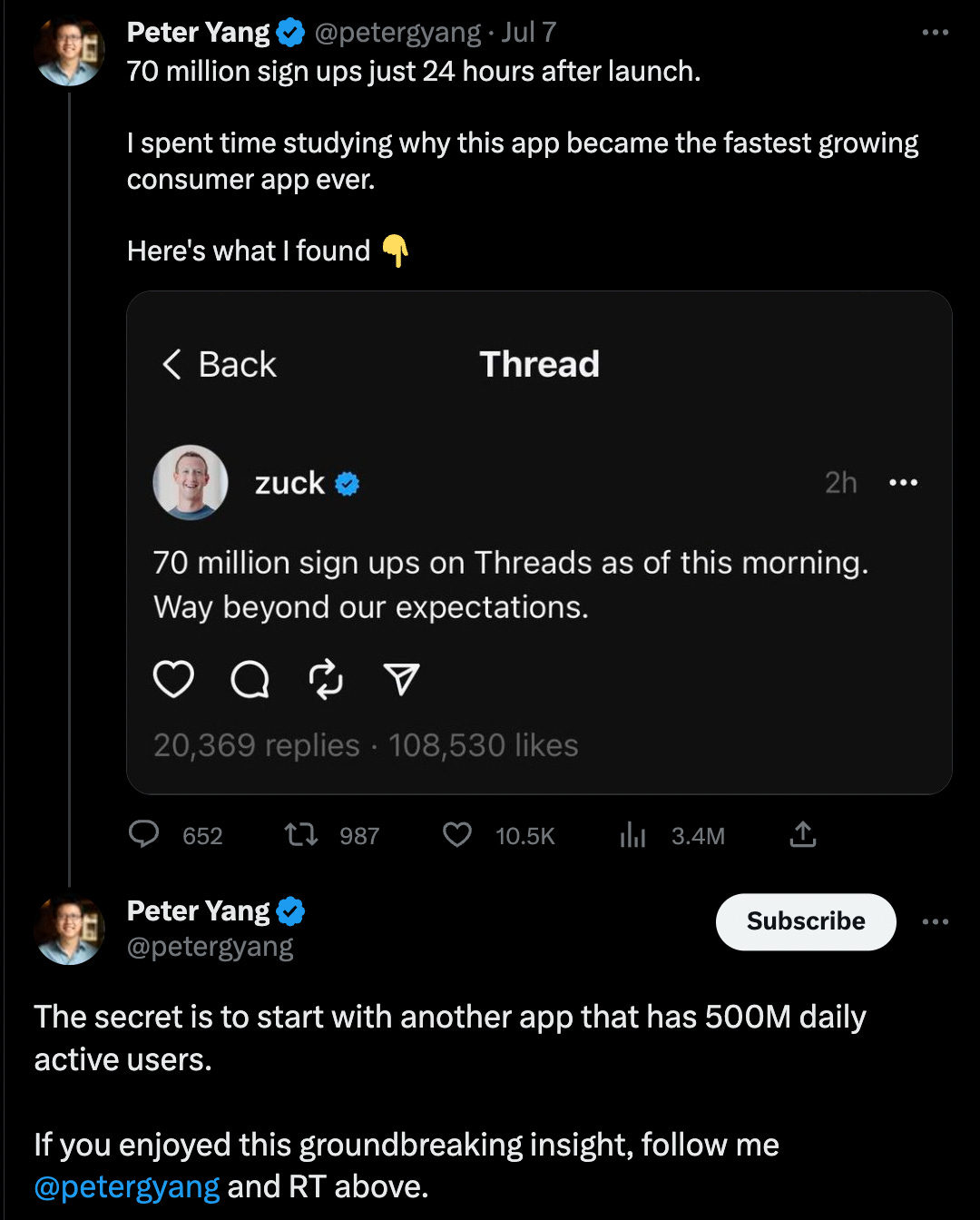
I’ve intentionally ignored the Elon-aphant in the room that very clearly gave birth to Threads in the first place— Mosseri told Hard Fork that they launched when they did despite not being ready for the EU because they would “miss their window,” referring to the multiple misfires at Twitter that got everyone looking for alternatives. But regardless of the fact that Elon is seemingly running Twitter into the ground, there’s legitimate hope that Threads will able to innovate and evolve in ways that distinguish itself from competitors because it has Instagram on its side. That fact has already helped it quite a bit: